
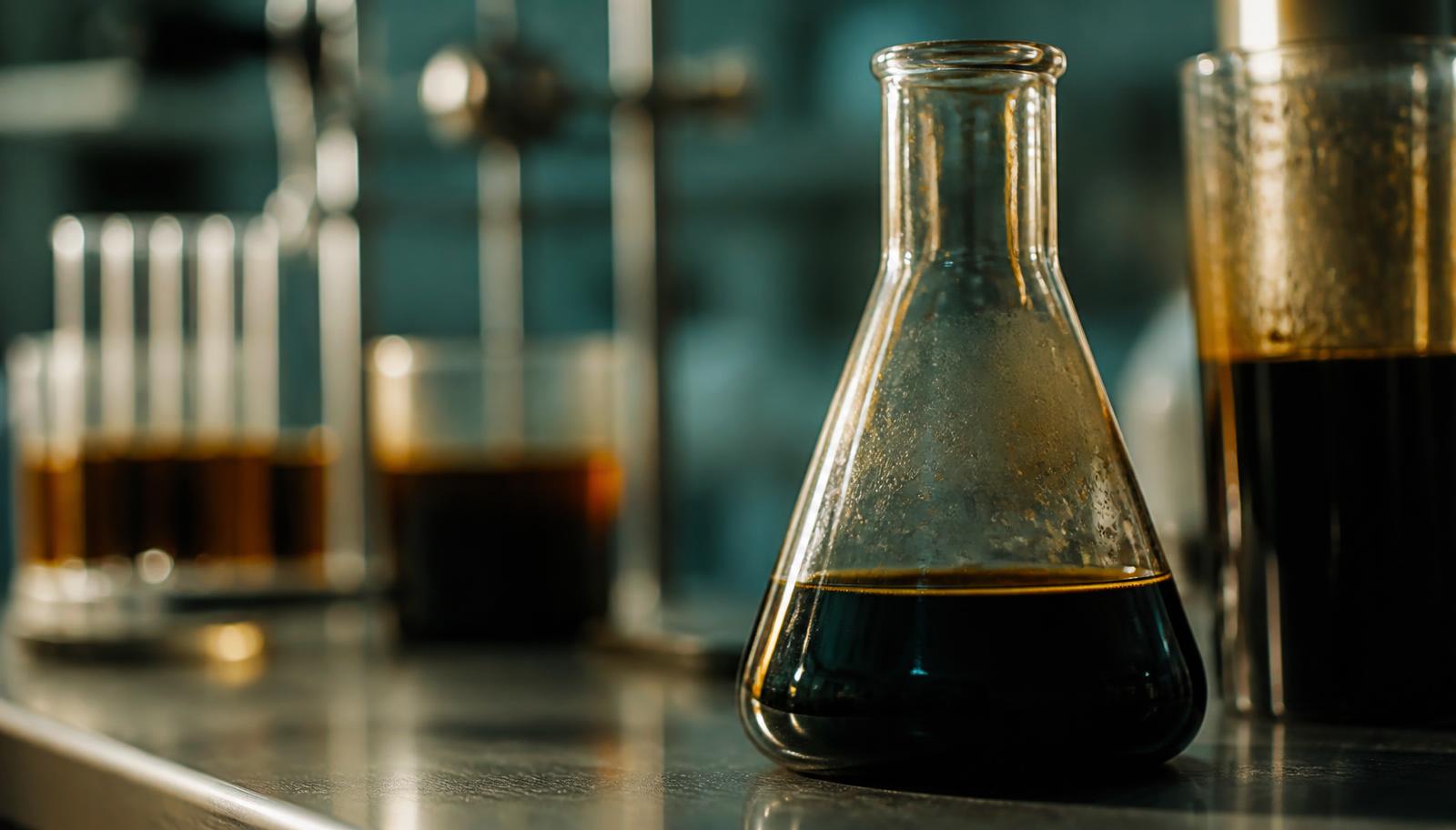
Fast pyrolysis is a deceptively simple idea. Heat biomass to roughly 500 degrees Celsius in the absence of oxygen, hold it there for a second or two, quench the vapours, and a large fraction of the feedstock leaves as a dark liquid. The conversion is fast, the yields are high, and the equipment is well understood. The difficulty starts afterwards.
The liquid that comes out is not a fuel. It is a chemically crowded mixture with high oxygen content, dissolved water, acids, sugars and reactive carbonyls. Left alone it ages: viscosity climbs, phases separate, and what was pumpable at the start of a week is a problem by the end of it. Feed it directly to a hydrotreater and the catalyst pays the price.
The specification gap
Refineries do not buy chemistry, they buy specifications. A co-feed has to arrive within a narrow band of acidity, water content, solids, metals and thermal stability, and it has to stay there in a tank. Most bio-crude fails that test not because the carbon is wrong but because the material was never conditioned to meet it.
- Oxygen content that drives hydrogen consumption up and catalyst life down
- Total acid numbers well outside what carbon steel systems tolerate
- Reactive species that keep polymerising in storage
- Fine char and alkali metals that foul downstream equipment
The bottleneck in this industry is not making bio-crude. It is making bio-crude that a refinery will take without renegotiating its whole operating envelope.
Sanjeev Gajjela, Founder & CEO
Fractionation before upgrading
PySAF's approach is to split the problem instead of hydrotreating through it. The bio-crude is fractionated into a stabilised, hydrotreater-ready stream, PyXCrude, and a fermentable C5/C6 sugar stream, PyXSugra. Each half then goes to the process best suited to it, rather than forcing one severe upgrading step to handle everything at once.
The practical consequence is lower hydrogen demand per litre of finished fuel, longer catalyst runs, and a second revenue stream from material that would otherwise have been a hydrogen sink. It also means the aviation fuel case does not have to carry the entire economics of the plant.
What we are proving next
Bench chemistry is necessary but never sufficient. The work that decides whether a conditioning platform is real is continuous operation: hours on stream, consistent product between batches, and behaviour that holds when feedstock quality moves. That is where our current programme sits, supported by instrumentation and academic partners working on the hydrotreating side.
If you operate a pyrolysis unit, own feedstock, or run a refinery evaluating biogenic co-feeds, we run structured evaluation programmes under NDA, from sample analysis through to co-processing trials.